

Consciousness, AI and the Human Voice
People fear that AI may one day become conscious. Consciousness is the basis of my work. My whole career is built upon it, so any question regarding Consciousness interests me. I frequently say, “Consciousness is the Final Frontier.”
Teach, Don’t Surrender
Recently, I was on Zoom with Trixie, whose title is “Student Success Supervisor” (which doesn’t begin to describe what she does for my company). She and I were working on revising a document when she commented that she needs to learn to use AI from me. She noticed that I would ask AI for an idea to word something, and then I would let AI know that I didn’t like the wording and I would ask AI to learn FROM me how I prefer to word something and why.
Trixie went on to explain how she’s noticed that a lot of her friends think that AI writes better than they do… that if AI suggests something, they immediately assume it must be an improvement, but watching me work with AI, she sees that I don’t make that assumption. In fact, while I sometimes find value in something AI suggests, I almost never use it verbatim.
The AI “Accent”
You know how when you meet someone from France, you always know they are from France? A French accent is very distinguishable. To me, AI “has an accent” in the sense that it writes a certain way.
It uses double dashes — all the time — and that is a strong indicator that something was written by AI.
It also tends to write short sentences.
In a column.
For dramatic effect.
You get the idea.
How I Use AI
I tend to use AI to flesh out ideas when I have something percolating in the back of my mind, or when I am considering something and I need different perspectives to help me see my own blind spots. But I never let AI write for me. Yet, programmed to be helpful, AI always wants to write for me. YUK! There’s that damned “AI accent” again!
Teaching is in my blood. My dad was a university professor. His dad taught high school. So when I work with AI, I can’t help it: I have to teach it. I explain to it why something it said is not correctly worded or why I prefer to say something in another way, rather than what AI suggested.
 “One is Me and One is You”
My ego is also involved in my AI interactions. It will suggest something, and I will do something totally different than it suggested, and then, I paste what I did into the AI chat, letting it know that I chose to do X instead of Y. The hilarious thing is that AI then STILL tries to say, “Ok, but I would change this one thing from X to X-1.” In other words, it still attempts to make “one small correction” or “one small improvement”.
This morning, when it did that very thing, I said, “Nope. I am keeping it the way I wrote it, because one is me, and one is you.”
That is the point of this blog.
Retain Your Own Sense of Who You Are
When you use AI, be sure to retain your own sense of who you are. AI isn’t necessarily smarter than you. And even if you are sure it is, AI can never replace your personality or your lived human experience. AI always shifts the tone of everything toward “cognitive processing language” rather than speaking from the heart – because it doesn’t have a heart.
I have a strong instinct to protect my authentic voice and you should, too! AI will change everything you write into something that sounds like it was written for a corporate board meeting. Too many people surrender their individuality and their own personality once AI gets involved. They turn off their critical thinking skills.
Just Because it is Articulate Doesn’t Mean it is Alive
Remember that AI has never lived a life. You have! It has no lived experience behind any of its words. You do! AI can recognize patterns, imitate authority, smooth out language, and bring up a variety of ideas for how to word things. That can be helpful. But it cannot replace your experience, your emotional responses, or your understanding of what it means to be a human being.
Too many people are beginning to confuse AI’s fluency with human wisdom, or AI’s linguistic polish with understanding. But remember: AI can make something sound complete when the idea hasn’t really been thoroughly examined.
Trixie and I noticed something important: People stop examining AI’s output the minute something sounds articulate. They think, “Oh, this sounds good. This will make me sound smart.”
Danger! Danger!
That’s dangerous, especially when we are discussing topics concerning spirituality, healing, human development and/or consciousness. Well-written language can persuade people, convincing them to adopt certain conclusions as fact when they aren’t even true.
 CRV’ers Have an Advantage
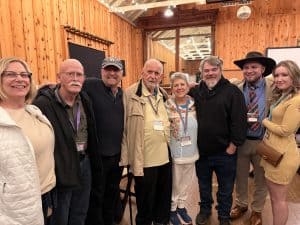
CRVers have an advantage when it comes to discerning truth from lies. We have been trained to discern true intuitive perceptions from analytic overlay. We learn to avoid labeling or making premature assumptions about a target. These are the same skills you now need to use when using Artificial Intelligence.
CRV training may be preparing you for the AI era better than any other form of education you could get, because you are learning how perception can become distorted when attempting to get answers.
Don’t Outsource Your Mind!
The minute anyone thinks that “AI probably knows better than I do about (who I am, or how I sound or what I mean)…” that person has begun outsourcing ownership of their own mind.
Refusing to allow AI to dominate your writing or your thinking is cognitive sovereignty. (I love that term!)
This article is about more than just “How to Use AI”. I am asking you to think about what happens when we humans surrender our sovereignty to perfectly-worded platitudes.
As a CRVer, you have an edge most people do not have, because you already are familiar with Stray Cats, AOL’s, making assumptions, jumping to conclusions, and the dangers of believing something too strongly without examining it thoroughly. What if AI is the new, giant AOL that is threatening humanity?
When Did We Give Ourselves Away?
Years ago, humans began surrendering their sovereignty to big institutions, corporations, religious organizations and governing bodies. We continue to do that, along with believing every YouTube “expert” and all the various “authorities” on social media. Now, with AI, we are surrendering our very souls to algorithms.
AI can be helpful to shape the way we phrase things. For example, if I am very angry, I can ask AI how to write a letter expressing my anger, but to help me do it in a way that won’t burn a bridge to someone I love. Then, I can take what AI wrote, and rewrite it to make sure it still carries the message I need to convey, written in my voice but … without the fury.
We all hear that the big danger of AI is that “AI may become conscious.” What if the real danger is not that AI becomes conscious… but that humans become less conscious?
Find the Balance… and Always Look Deeper
Perhaps the key is to find a balance between worshipping AI and rejecting it entirely. Cherish how rare it is to be human. Preserve your humanity and your sovereignty. And remember that, as a remote viewer, you have skills to see beyond the surface of life. Honor those skills and use them in your day-to-day activities. What makes you stand out in life is that you always look deeper.
It’s my hope that this message has found its way to you and that you find it to be helpful in some way. I’m honored to be a part of your journey.
Much love,
PS – If you haven’t yet taken a CRV course, you can check out my 6-week Practical Remote Viewing video course with a 14-day return policy, in case you decide it’s not for you. Use the coupon code IamMe30 to get 30% off.

Oh, Lori, thank you for this as I had to write up a “blurb” about our little Grange in Marcola for a scholarship presentation. I was tempted to check with AI but because I haven’t ever used it, I went with my own “Spiel.”
My favorite line from your post is: Cherish how rare it is to be human.
Thank you ever so much and great love to you and Jim.